
Why we never grind your coffee.
Coffee tastes best minutes after it is ground, not weeks. Why every Flying Frog bag ships as whole beans — and a quiet tour of the grinders and brewers we would put in your kitchen.
The moment coffee is ground, the clock speeds up. A whole bean protects its aromatics inside a dense, roasted cell structure; the instant you break it open, the surface area multiplies a thousandfold and oxygen, light and moisture begin taking the coffee apart. Ground coffee loses the top of its fragrance within hours, and most of what made the lot interesting within days. That is why every bag we roast leaves the roastery as whole beans, with a roast date on the front — and why the grinder, not the brewer, is the most important purchase a home brewer makes.
01Freshly ground, just before you drink
Roasted coffee is full of volatile compounds — the floral, fruity, caramel notes you pay for in a good lot. In a whole bean they are trapped. In ground coffee they evaporate, and what does not evaporate oxidises. The same bag, ground fresh each morning, will out-taste a pre-ground bag by a distance that surprises people the first time they compare them side by side.
This is also why we roast light and rest the coffee. A fresh light roast keeps releasing carbon dioxide for weeks; grinding just before brewing lets that gas escape in the bloom rather than in storage. If you do not own a grinder yet, tell us your brewing method in the checkout note and we will grind your bag for you — but treat it as a bridge, not a destination.
02The grinder is the upgrade
Ask any roaster where to spend your first hundred euros and the answer is always the same: the grinder. Consistency of particle size decides extraction more than any dripper, kettle or scale. A good grinder makes a cheap brewer taste expensive; a bad one makes an expensive brewer taste muddy.
Happily, the options have never been better — from sixty-year-old mills found in a Dutch kringloop to hand grinders machined like camera lenses.
03The old-school Dutch mills
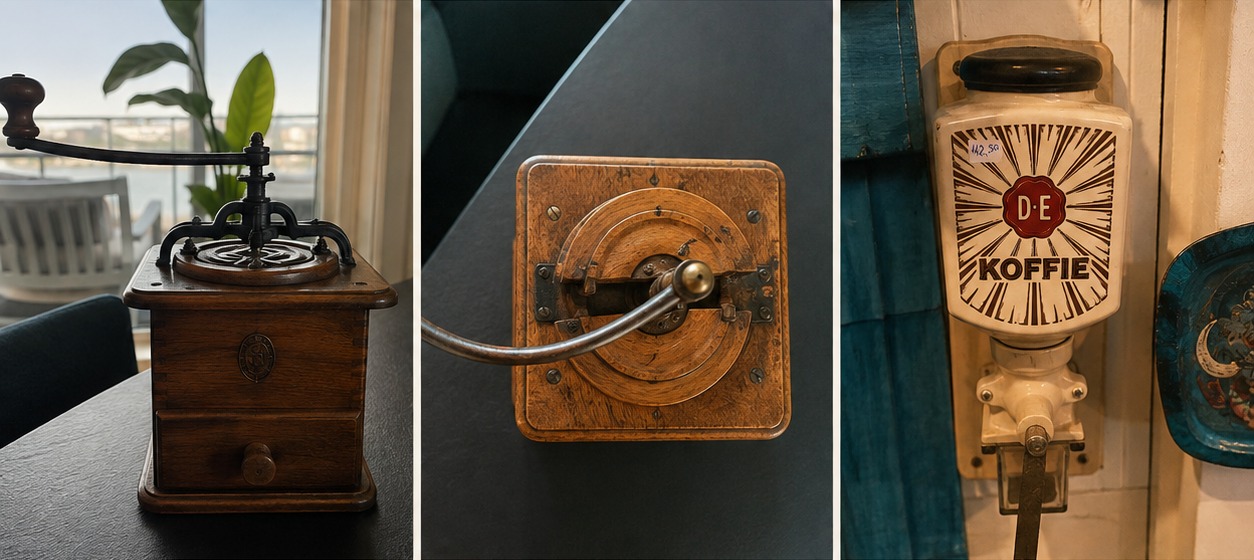
The Netherlands has a long affection for the coffee mill — the wooden box grinder on the counter, the cast-iron hand mill, the wall-mounted porcelain koffiemolen with its glass catching jar. They turn up constantly in kringloop shops and at markets for a few euros, and most of them still work, because there is almost nothing in them that can break.
For the kringloop shopper they are a lovely, honest starting point: slow, quiet, and built before planned obsolescence existed. Check that the burrs still bite evenly and give the mechanism a clean. What they lack in precision they repay in charm — and they will certainly outlast us all.
04Our favourite: the 1ZPresso hand grinder
If you ask us for one recommendation, it is a hand grinder from 1ZPresso, a small Taiwanese maker that machines its burrs and bodies to a standard the big electric brands rarely match. The grind is consistent enough for both filter and espresso, the adjustment is precise and repeatable, and the whole thing costs a fraction of a serious electric machine.
We also like what it does to the ritual. Two minutes of turning the handle is a built-in pause — a proper break in the day, with the smell of freshly ground coffee as the reward at the end. For slow mornings and anyone who drinks coffee as a moment rather than a fuel, it is the best option we know.
05Precision electrics and the robot barista
If you want an electric grinder that simply disappears into the routine, the Fellow Ode Gen 2 is the one we point to: a dedicated filter grinder, quiet, fast and very consistent, with burrs designed for clarity rather than espresso. It does one thing and does it properly.
At the other extreme sits the xBloom Studio — a machine that weighs, grinds and pours for you, a small robot barista that reproduces a recipe exactly, cup after cup. It is not how we brew at the roastery, but for an office or a household that wants pour-over quality without the pour-over learning curve, it is genuinely impressive.
06What to brew it with
For filter, our own daily setup is a Hario server with an Origami dripper — the Origami's ribs suit both conical and flat-bottom papers, which makes it the most forgiving dripper we own. The Dragonfly dripper is another favourite: fast, even draining and very consistent from cup to cup.
For espresso at home without a machine, the ROK is the charming answer — a manual lever press that runs on kinetic energy alone, no electricity, no pump. Pulling the levers down by hand is half the pleasure, and with fresh beans and a good grinder it makes a genuinely good shot.
07For parties and for summer
If you are brewing for guests and want a little theatre, a vacuum coffee maker — the siphon — is hard to beat: water rises into the top chamber, the coffee brews in full view, then the whole thing draws back down in one clean motion. It makes a beautifully clear cup and an even better conversation.
And for the warm months, cold brew made slowly in a Tiamo tower is the most elegant way to drink our lighter lots cold — drip by drip over several hours, sweet and floral over ice.
None of these links are sponsored; they are simply the tools we use, recommend or enjoy. Whole beans stay at their best for about three months from the roast date — ground coffee, for days.